
What lactoferrin is and why it is made by fermentation
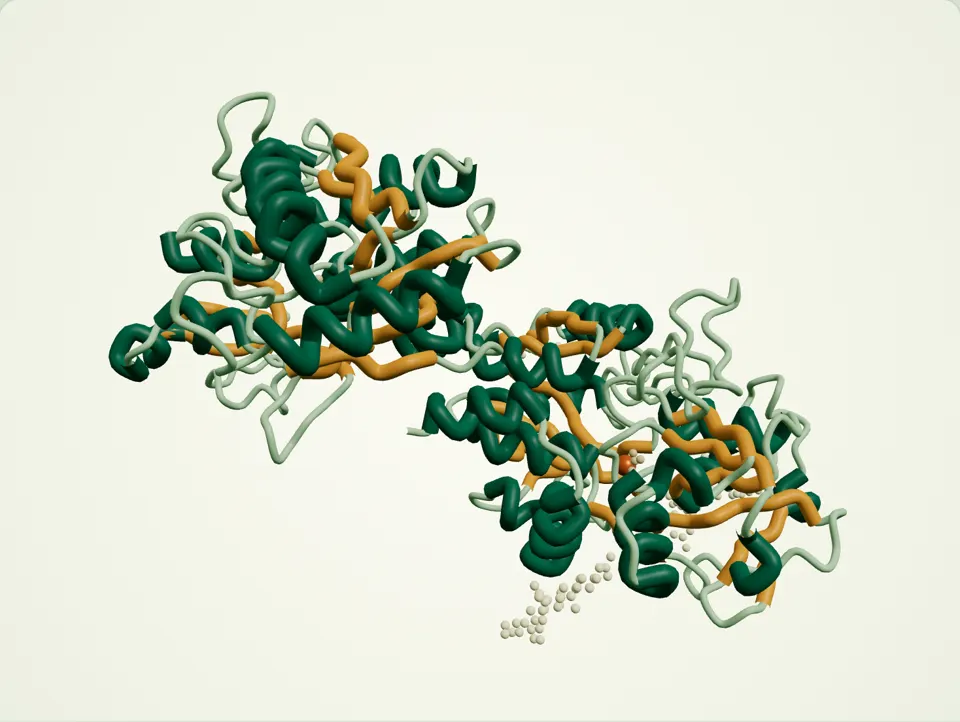
Precision fermentation lactoferrin is a version of the iron-binding glycoprotein, about 80 kDa in size, that occurs in milk, saliva, tears and nasal secretions. The protein has 601 to 700 amino acids folded into two globular lobes, each holding one ferric iron ion. The pink colour of the iron-saturated form earned it the nickname pink gold.
It is a minor milk protein, so extraction from milk cannot scale easily. A 2025 review states that extraction from milk is inadequate for large-scale therapeutic applications, which is the core argument for recombinant production. Microbial fermentation offers a supply that does not rely on dairy herds, with high and consistent product purity.
Precision fermentation lactoferrin is made by inserting the gene for bovine or human lactoferrin into a host microbe, usually the yeast Komagataella phaffii, also known as Pichia pastoris. The yeast secretes the protein into the broth, and downstream steps separate and purify it. The product is a powder or solution with the same sequence as the natural protein.
Other platforms exist. Researchers have expressed lactoferrin in bacteria, in rice and in the milk of transgenic cattle and goats, with milk yields reported from milligrams to tens of grams per litre. Those routes raise different issues, such as ethical concerns about genetic modification of animals, which is why yeast fermentation is the favoured route for food ingredients.
Precision fermentation lactoferrin production and purity
Yeast expression has been tested for many lactoferrins. In reported studies, Pichia pastoris GS115 produced bovine lactoferrin at about 825 mg per litre, and strain KM71-H reached 3.5 g per litre. Equine lactoferrin reached only 40 mg per litre in another system, so yield depends strongly on species, vector and strain.
Glycosylation is a known challenge. Yeast adds sugars to proteins in a different pattern from mammals, and the review notes that unsatisfactory translocation and N-glycosylation in some hosts differ from human glycosylation and may cause immunogenicity concerns. For food use, the regulatory focus is on whether the product is equivalent to milk lactoferrin and safe at the intended use levels.
Purification determines quality. Immunoaffinity chromatography is reported to give yields of 77 percent with more than 90 percent purity from sweet whey, and ultrafiltration and dialysis remove salts and small molecules. A commercial recombinant human lactoferrin from Komagataella phaffii is reported at above 98 percent purity, which illustrates what fermentation-derived routes can deliver.
A specification should state protein purity, iron saturation, residual host protein and DNA, endotoxin, heavy metals, salt, moisture and microbiology. Lactoferrin is used at tiny doses, so even small impurities matter less in absolute terms, but they still need control. Buyers should also ask whether the lot is iron-saturated or apo form.
Iron binding, function and nutrition
Iron binding is the defining property. Each lobe binds one Fe3+ ion with high affinity, and the review describes the two forms: apo-lactoferrin, lacking iron, plays a role in protecting against microbes and modulating immune responses, while holo-lactoferrin, carrying iron, supports transport of iron to cells. The balance between forms is part of its biology.
The same property supports nutritional claims. The review reports that lactoferrin enhances iron absorption in both breastfed infants and adults. It also describes antibacterial and immunomodulatory effects, which drive interest in infant nutrition and supplements. Claims in each market must follow local rules, and clinical evidence for recombinant material should be assessed on its own.
As a protein, lactoferrin is a minor nutritional contributor because of its low use level. FDA notice 1219 describes use at 0.04 to 0.25 percent in nutrition bars, nutritional beverages and powders, up to 0.4 percent in powdered milk and up to 3 percent in chewing gum. The role is functional and bioactive, not bulk protein.
Colour and stability matter. The iron-saturated form is salmon pink, which can tint pale products, while apo-lactoferrin is nearly colourless. Heat sensitivity and pH behaviour depend on iron saturation and the matrix, so a stability study in the final product is essential before launch, particularly for beverages that are heat treated.
Precision fermentation lactoferrin regulation
In the United States, FDA closed GRAS Notice 1219 on 7 May 2025 with a no-questions letter. The notice covers recombinant bovine lactoferrin isolate from Komagataella phaffii M020, intended for chewing gum, ice cream and frozen desserts, non-dairy milk, powdered milk, bars, beverages and yogurt at the levels in the notice. The notifier was TurtleTree.
A second letter followed. GRAS Notice 1284, for recombinant bovine lactoferrin isolate from Komagataella phaffii strain Ppas_337, closed on 25 March 2026 with a no-questions letter, with use as an ingredient in foods at the maximum levels in the response letter. The notifier was All G. Strain-specific notices are the norm for precision fermentation products.
Cow milk-derived lactoferrin has a longer record. FDA closed notices 67, 77, 130, 465, 464 and 669 with no-questions letters, with GRN 669 in 2017 covering infant formula at 100 mg per 100 g of formula solids and follow-on formula at 15 mg per 100 mL. Earlier human lactoferrin notices, including rice-derived ones, were closed at the notifier’s request.
In the EU, microbially produced lactoferrin is a novel food under Regulation (EU) 2015/2283 and needs an EFSA assessment before sale. The SFA list dated 14 August 2026 has no lactoferrin entry. Companies should therefore plan market by market, and should not assume that a United States no-questions letter carries over to other jurisdictions.
Applications and sourcing
Target uses are nutritional powders and beverages, and the uses listed in the notices, bars, yogurt, frozen desserts and chewing gum, as in the FDA notice. In these products lactoferrin is a premium functional ingredient, dosed in the tenths of a percent range. Infant formula is the best-known use of milk-derived lactoferrin, though recombinant forms follow separate approval routes.
Supply is concentrated in a few companies that run yeast fermentation and purification. Buyers evaluating suppliers should ask for the host strain, production scale, purity and iron saturation by lot, residual host material, allergen statement, glycosylation data, stability data, and the regulatory status in each market. Price is high, so doses and claims need careful calculation.
Precision fermentation lactoferrin compared with other fermentation proteins
Lactoferrin differs from the bulk ingredients that fermentation can supply and whose uses are far wider. Precision-fermented casein and precision-fermented whey are meant to replace large quantities of dairy protein such as whey protein, whereas lactoferrin is a high-value bioactive dosed in small amounts, and so it reaches the market sooner and at lower volumes.
Compared with milk-derived lactoferrin, the recombinant form offers independence from dairy supply and, in principle, consistent purity, but it has a shorter safety record and strain-specific approvals. Buyers who need infant formula use should check the regulatory position carefully, since approvals for foods in general do not automatically extend to infant products.