
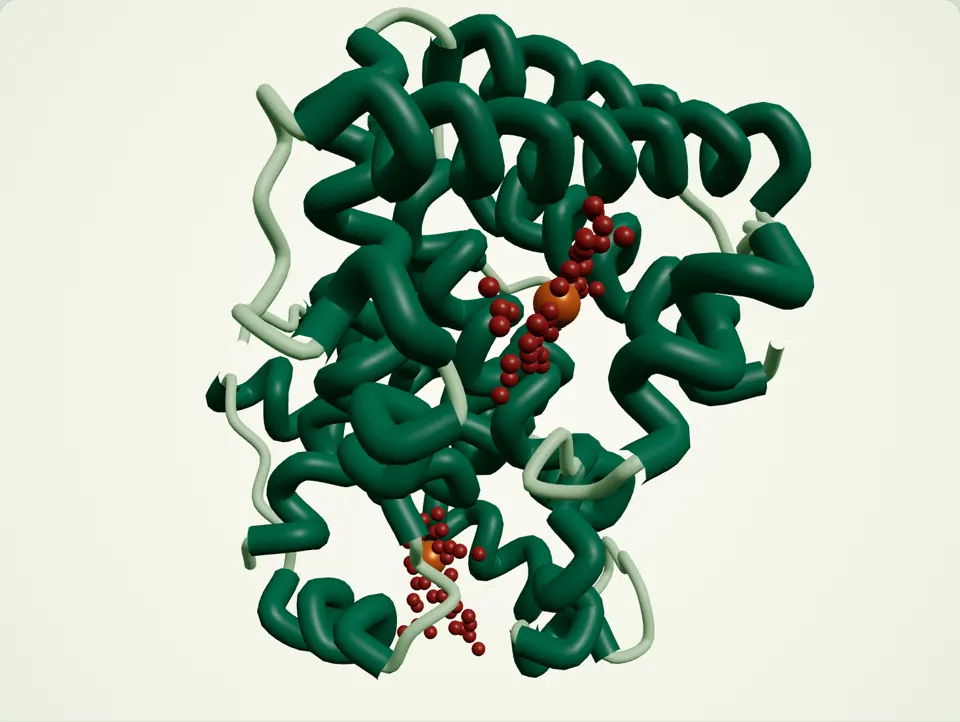
What leghemoglobin is and why meat analogues use it
Leghemoglobin is a heme protein that legumes make in their root nodules to carry oxygen to nitrogen-fixing bacteria. Its heme group is the same type of iron-containing cofactor found in myoglobin and haemoglobin. In plant-based meat, the protein is valued for what the heme does on a griddle: it colours the raw patty red and drives meat-like flavour.
The ingredient in commercial use is soy leghemoglobin made by fermentation, not extracted from nodules. A gene coding for the soybean protein is introduced into a methylotrophic yeast, Pichia pastoris, now classed as Komagataella phaffii, which secretes or accumulates the protein during culture. The result is a liquid preparation, called LegH Prep, containing leghemoglobin with bound heme.
The authors of the main toxicology evaluation describe LegH Prep as a flavour catalyst for plant-based meat and state that its heme cofactor is heme B, identical to the heme in animal meat. Regulators label it by function: a colour additive in the United States and a food additive used as a colour in the European Union.
Unlike a textured protein, leghemoglobin is used at very small levels and contributes almost no structure. The United States rule caps soy leghemoglobin protein at 0.8 % of an uncooked ground beef analogue. It therefore sits on top of a structural base such as textured vegetable protein or a soy matrix, which supplies the bite.
How the heme protein is produced and what the preparation contains
Production relies on a genetically engineered yeast. The EFSA GMO Panel records that K. phaffii strain MXY0541 was developed by introducing the LGB2 coding sequence for the soybean protein, and that its molecular characterisation raised no concern. The federal rule describes the yeast as non-pathogenic and non-toxigenic, and notes that the additive contains residual yeast protein as well.
Composition is stated by protein, not by a single compound. In the preprint of the toxicology study, the total protein fraction of LegH Prep contains at least 65 % LegH, with the remainder made of proteins from the Pichia host. Because the host proteins are part of what is eaten, they were assessed for toxicity and allergenicity as well.
Heme is the active part. EFSA reasons that the components of the additive will be digested to small peptides, amino acids and heme B, so consumers receive iron and amino acids rather than an intact foreign protein. It also notes that the heme iron supplied at the proposed uses is comparable to that from similar amounts of meat.
The use level in the toxicology work was chosen with beef in mind: the preprint reports use of up to 0.8 % LegH, selected to match beef heme levels. At that dose the protein imparts a meat-like flavour profile to plant-based products, which is why developers treat it as a flavour and colour system rather than a source of nutrition.
Leghemoglobin safety evidence and toxicology
The toxicology package is public. LegH Prep was non-mutagenic in the Ames bacterial reverse mutation assay and non-clastogenic in the in vitro chromosome aberration test. In a 28-day dietary study in Sprague Dawley rats, there were no mortalities and no clinical, body weight, ophthalmological, clinical pathology or histopathological changes attributable to the preparation.
Doses in the 28-day study were 0, 512, 1,024 and 1,536 mg/kg per day of preparation, equal to 0, 250, 500 and 750 mg/kg per day of LegH. The authors set a no-observed-adverse-effect level of 750 mg/kg per day, the highest dose tested, and state it is over 100 times the 90th percentile daily intake.
The EFSA FAF Panel reached a similar view. It found no genotoxicity concern and no adverse effects at the highest dose tested in the available studies, and concluded that no numerical acceptable daily intake was needed at the proposed use in food category 12.9. Iron exposure at mean and 95th percentile intakes stayed below the NDA Panel’s safe levels.
Allergenicity was assessed separately. The EFSA GMO Panel did not identify concerns about toxicity or allergenicity of the soy protein as expressed in K. phaffii, and found no evidence that the genetic modification would change its overall allergenicity. In the United States, the labelling rule still treats the soy-derived protein as a major allergen source.
Regulatory status in the United States and Europe
In the United States, FDA amended the colour additive regulations to permit the soy protein in ground beef analogue products, codified as 21 CFR 73.520. The final rule was published on 1 August 2019 with an effective date of 4 September 2019. An administrative stay followed objections and was lifted on 19 December 2019, after FDA denied all six.
The rule’s restrictions are specific. The soy protein must not exceed 0.8 % by weight of the uncooked ground beef analogue, the additive is exempt from batch certification, and foods containing it must be labelled for soy. FDA also declined a request for labelling that names the Pichia yeast protein, because yeast protein is not a major allergen.
In the European Union, the FAF Panel published its opinion on 28 June 2024 and the GMO Panel followed on 15 November 2024. The first covers the additive itself, with its provisional status tied to the second, which concluded that the genetic modification does not lead to safety issues. These opinions are scientific advice; sale also requires an authorisation decision.
Developers should check each market separately. Nothing in the United States rule extends the use to cooked products, fish analogues or other meat categories, and EFSA’s opinion relates to food category 12.9 and a stated maximum use level. Any change in the product category, in the host strain or in the protein content of the preparation can reopen the assessment.
Sourcing and comparison with other heme and meat-flavour routes
Buyers of the ingredient should request the specification, including the LegH share of total protein, the iron content, the host strain identity and the lot analyses, plus a statement of the regulatory instruments covering the target market. Both regulators assessed a defined preparation from a defined strain, so a different host or protein content cannot borrow those conclusions.
Fermentation can make other heme proteins. Precision-fermented myoglobin uses the muscle pigment of animals as its template, while the legume protein carries the soybean sequence. Both follow the same logic as precision-fermented egg white: the gene for a defined protein is placed in a microbial host, and the secreted protein is recovered from the culture.
Other routes to a meat-like profile rely on different ingredients. Mycoprotein is a fungal biomass valued for fibrous texture, and savoury character can also come from yeast-derived or reaction flavours. Those options do not contain a heme cofactor, so developers weigh them against the colour and flavour behaviour that the toxicology evaluation attributes to heme in meat analogues.
Cultivated products reach a similar sensory goal by growing animal cells, which bring their own muscle pigment. Where cultivated meat is blended with plant protein, developers can still consider a colour additive. For most teams the decision comes down to whether the regulatory scope, the soy allergen label and the cost of the ingredient justify the sensory gain.