
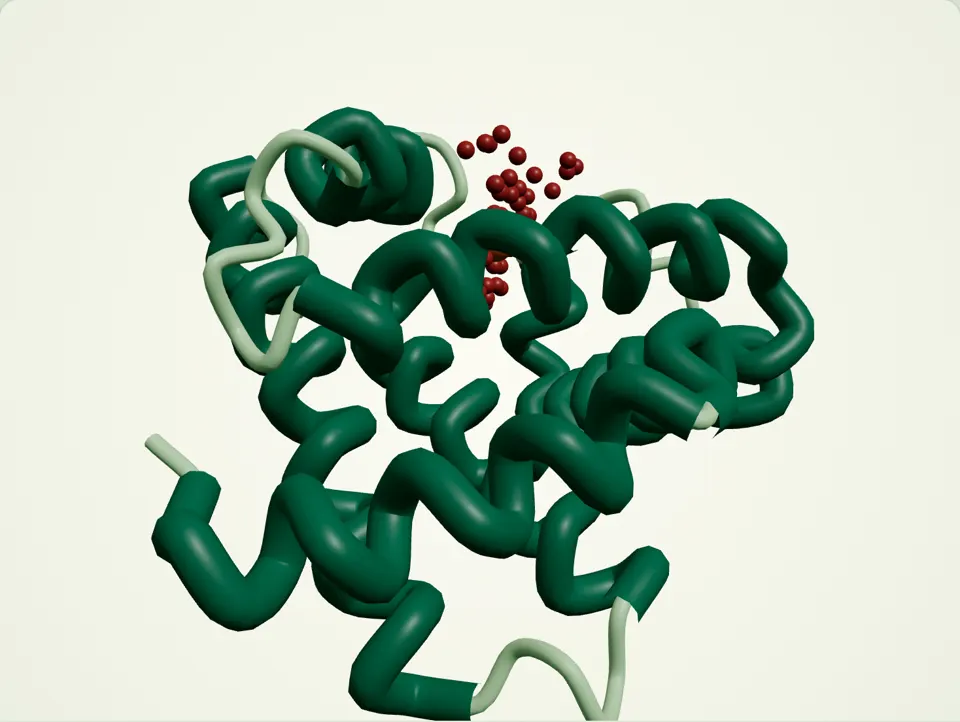
What precision fermented myoglobin is and how it is made
Precision fermented myoglobin is a heme protein produced by a microorganism rather than extracted from animal muscle. Myoglobin stores oxygen in muscle and gives raw meat its red colour, and cooked meat much of its characteristic aroma. A yeast host is engineered to make a protein with the same sequence as the bovine one.
The FDA record for the best-documented example describes a Pichia pastoris production strain. It carries a synthetic gene for Bos taurus myoglobin, codon-optimised for the yeast, plus synthetic genes for eight native enzymes of the heme biosynthetic pathway and an extra copy of a transcription factor gene. Myoglobin needs heme to function, so the strain is built to make both.
Downstream steps are simple compared with powder proteins. After fermentation, the cells are washed and lysed, debris is cleared with a phosphate buffer, and the lysate is centrifuged and microfiltered. Ultrafiltration concentrates the myoglobin, which is stabilised with salts, ascorbate and food-grade antimicrobials and antioxidants. The preparation is stored as a frozen liquid at minus 20 degrees Celsius.
Precision fermented myoglobin composition and specification
This is not a bulk protein ingredient. The notified myoglobin preparation is a liquid composed mainly of water, with myoglobin protein, yeast proteins, ash, fat and carbohydrate. Its specification requires myoglobin at 3 percent or more, at a purity of at least 65 percent by weight of solids, with total organic solids of 7.5 percent or less.
Other specification limits are tight. Moisture is at least 92.5 percent, fat at most 1 percent, carbohydrates at most 0.5 percent and ash at most 1.5 percent, with a pH of 6.5 to 8.5 and a lead limit of 0.01 milligrams per kilogram. Three batches were analysed to show that the manufacturing process can meet these values consistently.
Identity is the central claim. The notifier states that the myoglobin has an amino acid sequence identical to bovine myoglobin, with the UniProt identifier P02192. Because the preparation also contains yeast proteins, regulators ask for production strain details, absence of antibiotic resistance genes and an assessment of host proteins, which the precision fermentation allergenicity literature treats as routine.
The ingredient is dosed in grams per kilogram, not in tens of percent. Because the use level is capped at 2 percent myoglobin, the nutritional contribution is negligible, and the product serves a sensory purpose. That is why the protein content field on a card for this ingredient reflects a specification floor, not a nutritional profile.
Flavour and colour of precision fermented myoglobin
Flavour is the declared function. FDA’s description of the notice states that myoglobin is used to impart flavour and aroma in ground meat and poultry analogues, up to 2 percent myoglobin. Heme proteins catalyse reactions during cooking that generate the roasted, bloody and iron-like notes consumers associate with beef, which plant proteins cannot easily supply.
Colour is the complicating factor. The notifier notes that myoglobin imparts a red colour when exposed to oxygen in some applications, and FDA responded that there is no GRAS provision for colour additives. Its response is not an approval as a colour additive, and uses that colour a product may require a colour additive listing.
Heat changes the pigment. The preparation remains a liquid dispersion up to 60 degrees Celsius, the protein starts to unfold at 40 degrees, and the heme iron changes from oxymyoglobin to metmyoglobin above 40 degrees, which alters the colour as the analogue cooks. That behaviour resembles the raw-to-cooked colour change of meat, which is part of its appeal.
Shelf life is limited and storage is cold. Based on quality and appearance studies of raw and cooked foods containing the preparation, the notifier estimates a shelf life of 12 months when stored frozen. Manufacturers must therefore plan cold-chain logistics and thaw procedures, which is a practical difference from dry powders that store at ambient temperature.
Applications and uses
Meat analogues are the intended market. The FDA notice covers ground meat and poultry analogue products, such as burgers, sausages and nuggets built on plant protein. Developers of precision fermented myoglobin products add the preparation to the raw mix at a low level, then adjust fat, binders and seasoning to balance flavour, colour and juiciness during cooking.
Precision fermented myoglobin sits in a small family of heme proteins. The plant-derived analogue, leghemoglobin, serves a similar function in other burgers and has its own regulatory file. Developers choose between them on flavour, colour behaviour and label wording, and may evaluate both against structure builders such as textured pea protein and extruded legume blends.
Cost and scale shape the use. A review of precision fermentation notes that production costs for recombinant proteins are high compared with conventional proteins, though flavour proteins are used at low levels. That makes a heme ingredient affordable in a premium analogue even when bulk fermented proteins are not, which explains why the first commercial uses focus on flavour.
Regulation and allergen status
FDA completed its evaluation of GRN 001001 on 3 December 2021 and had no questions about the notifier’s conclusion that the preparation is GRAS for use up to 2 percent myoglobin in ground meat and poultry analogues. The letter adds that some uses may require a colour additive listing, and that it is not an affirmation of GRAS status.
The letter also states the notifier’s position on allergens. The components of the fermentation medium are stated not to come from major food allergens, and the protein itself is a muscle protein with a sequence identical to bovine myoglobin. The preparation includes Pichia pastoris proteins as well, so the allergen file addresses the host organism and the residual proteins.
Outside the United States, requirements differ. In the European Union a recombinant protein produced by fermentation would be assessed as a novel food, and a developer needs a market-by-market plan. Labelling terms also vary: FDA notes that its letter is not a recommendation on the common or usual name for the ingredient, and labelling counsel should confirm the wording.
Sourcing and supply
Supply is limited to the few companies that have built heme production strains and fermentation capacity. Because the FDA record names a single notifier for myoglobin, buyers should expect a concentrated supplier base, direct technical contact and frozen shipping. Contract terms often cover minimum volumes, shelf life on arrival and the right to audit.
Specifications should cover myoglobin content and purity, total solids, host-protein content, microbiology, heavy metals, pH, stabiliser composition and storage conditions. Ask for stability data in the intended matrix, including colour change on cooking, and for the regulatory dossier in each market. Request confirmation of how the colour additive question is handled for the specific use.
Trials should be run in the final formula with the final cooking method. Test dosage in steps below the notified ceiling, measure colour before and after heating, and run sensory panels against a plant-only control and against a meat reference. Document the findings, since labelling, claims and regulatory status depend on the exact use level and food category.