
What precision-fermented egg white is
Precision-fermented egg white is a protein ingredient in which a gene taken from the hen is expressed in a microbial host, usually a yeast or a filamentous fungus, so that the egg protein is secreted into the fermentation broth. The target is most often ovalbumin, the main protein of egg white. The broth is clarified and dried into a powder.
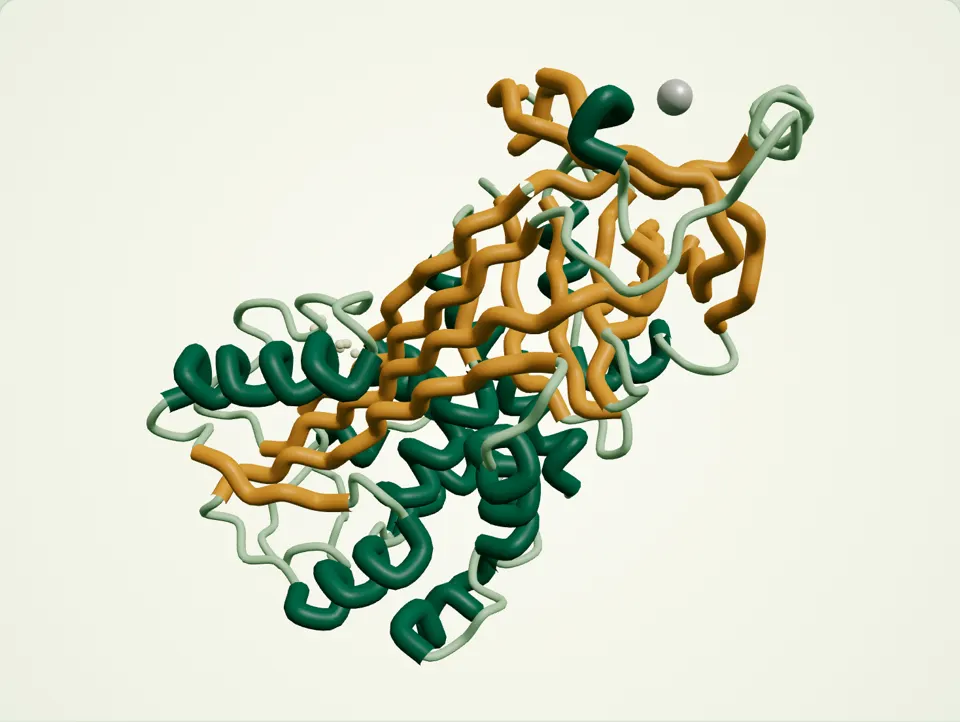
Ovalbumin makes up about 54 % of egg white protein. A GRAS notice describes it as a globular phosphoglycoprotein with a mass near 42.8 kDa, an isoelectric point of 4.5 and a chain of 385 amino acids. Because hen ovalbumin has long been eaten, notifiers argue that the recombinant protein shares that history of safe use, once identity is shown.
Other egg white proteins have followed the same path. FDA reviewed a soluble egg-white protein made of recombinant ovomucoid from Komagataella phaffii strain GSD-1209, and later notices covered ovalbumin from the same yeast species and from Trichoderma reesei. Each is a single protein or a small mixture, so none reproduces the whole spectrum of proteins in a hen’s egg white.
The commercial logic is substitution. FDA’s letter on the Trichoderma product records the notifier’s intention to replace whole eggs, fresh or powdered, and egg white protein powder in baked goods, beverages and other categories. The ingredient is therefore positioned against pasteurised egg products and powders, and it competes with plant alternatives only where egg functionality is the goal.
How ovalbumin is produced by fermentation
In GRN 001249, Onego describes a production strain, T. reesei TR112, derived from the host strain ATCC 13631 and carrying a codon-optimised, synthesised gene for Gallus gallus ovalbumin. Strain construction was checked by quantitative PCR and whole genome sequencing, and expression remained consistent over at least 75 generations. After fermentation the cells are removed and the liquid is clarified.
The clarified culture liquid is concentrated by ultrafiltration and diafiltration, filter sterilised and dried. Specifications in that notice require at least 75 % protein, of which at least 80 % is ovalbumin, with carbohydrate up to 20 %, fat up to 1.5 %, moisture up to 10 % and ash up to 5 %. Three non-consecutive batches were analysed to show that the process meets them.
The yeast route is similar in outline. A Clara Foods notice for an ovalbumin made in Komagataella phaffii specifies protein above 75 % w/w, moisture under 10 %, carbohydrate under 10 % and ash under 5 %. Three batches measured 86.06, 85.19 and 81.88 % protein as-is, and 92.8, 92.7 and 87.4 % on a dry-weight basis.
Titre and purity drive cost more than any other variable. A peer-reviewed study of T. reesei reported production of 2 g/L for recombinant hen ovalbumin at bioreactor scale. Host proteins that co-purify with the target can lower gel strength, so downstream steps are chosen to remove them while keeping glycosylation and secondary structure close to the native protein.
Ovalbumin functionality in food formulation
Foaming, gelling and binding are the three functions in every intended-use statement. The Trichoderma ovalbumin was reviewed as a source of protein and as a foaming, gelling and binding agent at maximum levels from 3 % in breads to 25 % in high-protein breads, smoothies with added protein, powders and bars. Egg analogues are listed at 12 % and meat analogues at 10 %.
Evidence from the peer-reviewed literature is more cautious. Aro and colleagues found that recombinant ovalbumin from T. reesei had excellent foaming and heat-induced gelation, yet the gel strength was somewhat lower than with hen ovalbumin. They suggested partial degradation or other host proteins as possible causes, which points to purity and protease control as levers for performance.
Structure and glycosylation matter for function. The same study found that secondary structures matched the native proteins and that the fungal ovalbumin was mostly N-glycosylated with Man5, a simpler glycan than the hen’s. Such differences can shift solubility, heat stability and gel networks, so each ovalbumin source should be tested in the real matrix rather than assumed equivalent.
Isoelectric behaviour guides formulation. With an isoelectric point near 4.5, ovalbumin is least soluble in mildly acidic systems, so foams and gels in dressings, mayonnaise-type emulsions or acidic beverages need pH, salt and heat settings checked. Pairing with hydrocolloids or with a second protein can recover firmness where the recombinant gel is softer than egg white.
Safety, allergen and regulatory status of precision-fermented egg white
In-vitro digestibility is close to native. In the yeast-ovalbumin notice, pepsin-digestible protein was 99.6, 99.7 and 99.3 % for three batches, compared with 99.3 % for native chicken ovalbumin. The notifier also reports matching amino acid sequence, molecular weight and immunoreactivity, and concludes that the product is substantially equivalent to hen ovalbumin.
Nutrition is another point of contrast. The yeast ovalbumin batches reached over 80 % protein as-is, in the range of dried egg white products, while protein quality for a recombinant ovalbumin should be confirmed by the supplier through digestibility testing. Whole-egg replacers also have to supply fat, lecithin and flavour, which a single protein cannot do.
Allergen labelling is unambiguous. FDA’s letter states that ovalbumin preparation requires labelling under the Federal Food, Drug, and Cosmetic Act because it contains protein derived from egg, and the yeast-ovalbumin notice commits to a statement such as Contains egg. Egg-allergic consumers are not served by the ingredient, whatever its animal-free production route.
The estimated exposure in GRN 001249 is 18.89 g per person per day at the mean and 39.17 g at the 90th percentile for people aged two and over. In the European Union, a recombinant egg protein would be assessed under the novel food regulation, so buyers should confirm the Union list entry before planning a launch there.
Sourcing and comparison with hen egg white and dairy proteins
Supply today comes from a handful of fermentation companies working with yeast or filamentous fungi, and from contract manufacturers that run the fermentation and drying. Buyers should request the production host, the protein specification, the share of ovalbumin or ovomucoid in the protein, the batch analyses and the allergen declaration, and compare them with the notice the supplier cites.
Compared with pasteurised hen egg white, precision-fermented egg white offers a defined composition and no dependence on laying flocks, yet it carries a narrower protein set. Hen egg white also contains lysozyme and ovotransferrin, among other proteins. A formulation that depends on that wider protein set may need a different ingredient or a blend.
Nutrition is another point of contrast. The yeast ovalbumin batches reached over 80 % protein as-is, in the range of dried egg white products, but no DIAAS value for a recombinant ovalbumin was found in the sources used here. Whole-egg replacers also have to supply fat, lecithin and flavour, which a single protein cannot do.
Alongside precision-fermented egg white, precision-fermented whey and precision-fermented casein share the same production logic, and the comparison of egg white protein with whey protein frames where egg proteins sit in sports and bakery applications. Developers should plan sensory tests, because the neutral powder will behave differently from fresh egg in cakes, meringues and scrambles.